
By Gina Horan
Inside FCC Coleman: Jenny Cote’s Calling Behind Prison Walls





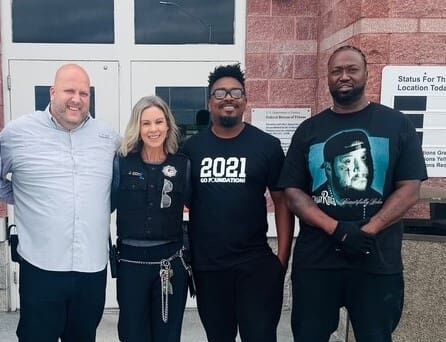
Jenny Cote is petite and energetic, with bright eyes and a smile to match. If you tried to guess where she works, a federal prison would never make the bingo card.
She is the mentor coordinator for Federal Correctional Complex Coleman in Sumter County, where she works across five facilities coordinating mentorship opportunities and faith-based programs for men facing different futures. Some are preparing to return home. Others may spend the rest of their lives inside.

Johnny Shelton is serving a life sentence at USP Coleman II, one of two high-security penitentiaries within the complex. In a letter to Jenny, he says she encourages him to put his battles in the Lord’s hands. The incarcerated men’s words throughout this story come from letters they wrote to her.
“She brings light to a dark place,” Johnny says.
Behind the walls
Their sentences help determine where they live and what comes next. Jenny begins with who they are when they walk into her classroom.
“I’m only able to look at the inmates from when I met them,” Jenny says. “While I may understand their backgrounds, I work with them from the perspective of a fresh start.”
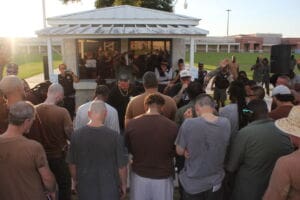
She understands that the decisions bringing these men to Coleman were made before she met them. They broke the law, went through the justice system and arrived at a federal prison.
Her approach requires her to hold two convictions together: The men must take responsibility for what they have done, and they still deserve an opportunity to change.
“The only way I can be truly nonjudgmental is because of my faith and what the scripture says,” Jenny says. “Jesus Christ tells me not to be the judge. That doesn’t mean that I don’t think people need to take responsibility for their actions. But I am true in my convictions. I’m sincere, and this is based on scripture.”
Classes, workshops and mentorship bring incarcerated men, staff and volunteers together. Schedules and curriculum provide structure, but relationships often develop in smaller moments.
At Coleman’s minimum-security camp, Dyakar Mallu remembers mornings when Jenny arrived at the chapel at 6:30am to pray with the men, although she wasn’t assigned to be there.
“Quiet, faithful, powerful. The kind that changes people, not through words, but through presence,” Dyakar says of her leadership.
Dyakar participates in Threshold and Godly Leadership, programs that emphasize personal responsibility, faith and service. He describes those mornings as an example of Jenny practicing what she teaches.
When it becomes personal
Jenny also knows what it feels like to have someone she loves on the other side of a prison fence.
Her brother, Adam, was incarcerated for four years. Her familiarity with prison life made his circumstances harder to bear.
“I was able to see not only what he faced, but I know what goes on behind those walls and fences,” Jenny says. “I knew what he slept on, what the cells looked like and it was really tough. I just would cry sometimes, and my co-workers and even some of my students got me through it.”
She received support again after her mother died suddenly in 2023. Jenny describes grief so overwhelming that, one day, she wanted to go with her.
“I ended up just on the bathroom floor sobbing, and God spoke to me and made me understand that he needed her more than I did,” Jenny says. “So I went back into work with a double dose of spirit, mine and my mom’s, and she is with me to this day.”
Her faith has helped her through those experiences and continues to shape her work. Jeremiah 29:11 holds particular meaning for her, offering reassurance about hope, redemption and a future.
Facing the past
Inside Coleman, helping men consider their future also means asking them to face their past.
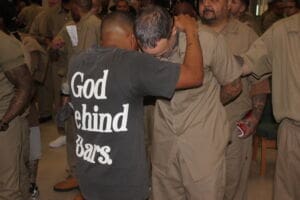
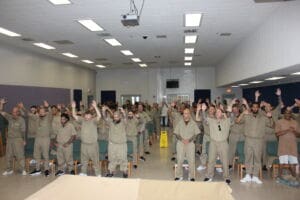
Threshold, a six-month program Jenny helps facilitate, examines relationships, personal responsibility and growth. Assignments and discussions challenge the thinking and behaviors behind participants’ choices.
One assignment asks them to write a letter to someone they have hurt. They don’t have to send it, but they do have to write it.
The exercise asks them to consider what someone else lost because of their actions, even as they reckon with their own circumstances.
“The transformation process is the most important thing for these inmates,” Jenny says.
A future beyond the time served
Richard Delapaz, incarcerated at Coleman Low, says Jenny’s Threshold talks “absolutely 100 percent make me want to be a better person.” His interest extends beyond the course. He wishes she could hold a Sunday service open to everyone, because he thinks so many of the men need her inspiration and guidance.
Duwaine Earl, also at Coleman Low, has signed up for every program he can and is still going. He is grateful to be part of Godly Leadership, he says, and describes walking with the Holy Spirit as he prepares for the next chapter of his life.
His questions include when he might move to a halfway house and, he hopes, a Christian-based home. For men approaching release, personal growth comes alongside the uncertainty of finding their footing outside.
“At FCI Coleman Medium, we recognize that effective, evidence-based programming plays a vital role in preparing individuals for successful reentry,” Warden B. Lott says.
The warden points to faith-based, educational, vocational and mentorship initiatives as opportunities to develop skills, stability and support networks.
“These programs strengthen institutional safety, support rehabilitation, and ultimately benefit the communities to which our inmates will one day return,” Warden Lott says.
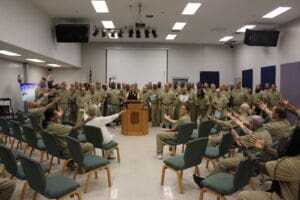
For Johnny and others serving life sentences, transformation must have meaning within the prison itself. There are still choices to make and opportunities to help someone else.
Many of the men are also working on relationships with wives, parents, siblings and children. Jenny says they lived selfishly and in survival mode before prison, which made those relationships harder to build.
“Seeing a life shift from absolute hopelessness to divine purpose is exactly why I do this work,” Jenny says.
Accepting their circumstances and recognizing they cannot manage alone can open the way to change, she says.
“Responsibility remains part of that process,” she says, “but no matter who, people deserve to feel wanted and loved, including the men behind these prison walls.”
Find Jenny in the pages of Style Magazine and hear her conversation on The Style Podcast.
Photos provided























Gina moved to Central Florida from the San Francisco Bay Area in 2021. She holds a degree in linguistics and has worked as a fashion editor, photo stylist, lifestyle columnist and food writer since 1995. She later covered travel, events, restaurants, music festivals and sports throughout Northern California, including work as a morning show host with KSAN radio and food critic for KRON Bay TV. A veteran bartender, she has worked in hospitality on and off since high school. Gina joined Akers Media in 2022 and is currently the Food and Lifestyle Editor. Her passions include travel, road trips, history books and podcasts, tasting menus and arriving in a new city without a map.