

By Frank Stanfield
James Duckett Set for Execution as Appeals Reach Supreme Court








After exhausting years of appeals, James Duckett, the former rookie police officer sentenced to death for the rape and murder of Teresa McAbee, an 11-year-old girl in Mascotte in 1987, is scheduled to be executed today at noon.

On Monday evening, however, Duckett’s attorney Mary Elizabeth Wells said she was “cautiously optimistic” because of two emergency filings before the U.S. Supreme Court. One deals with a continuing appeal for more clarity from DNA testing. The other, she says, is ‘the unconstitutionality of having two executions on the same day.”
Dominick A. Occhicone Jr., convicted of a 1986 double homicide in Pasco County, is set to be executed at 6pm. He is 80 years old.
Duckett, 69, claimed in his federal civil rights lawsuit that his Fifth and Fourteenth Amendment rights to due process were violated and so were his First and Fourteenth Amendment rights to access to the courts.

Circuit Judge Brian Welke in Tavares has held numerous hearings, hearing from local prosecutors with State Attorney Bill Gladson’s office, and the State Attorney General’s Office, as well as Duckett’s lawyer.
Assistant State Attorney Ken Nunnelley, who’s been handling the case locally has said, “It’s been a long time coming.”
Gladson, in a press release, spoke about the legal processes surrounding this case.
“From the beginning of this case, the evidence established the defendant’s guilt,” he says.”The physical evidence recovered, together with the facts developed during the investigation and presented in court, left no reasonable doubt as to James Duckett’s responsibility for this horrific crime.”
“The evidence was repeatedly examined through years of judicial review and withstood extensive scrutiny.”
The Florida Supreme Court last week rejected his sixth post-conviction appeal and second post-death warrant plea, following a July ruling that cleared the way for this death warrant.
The central issue was tests of DNA material found on Teresa McAbee’s underwear.

An FBI analyst stated at trial that pubic hair was consistent with Duckett’s. The kind of genetic evidence common today was not available during the 1988 trial — read our original coverage of the first death warrant and DNA testing order here.
Evidence technicians did find Duckett’s and Teresa’s fingerprints on the hood of his patrol car, and tire tracks that matched the car at the lake where her body was found.
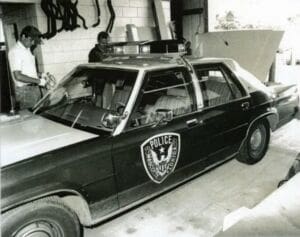
In 2003 an appeals court ruled that certain clothing items could be tested. The Florida Department of Law Enforcement concluded that a private lab using a genealogy type of examination would be best.
On March 27 of this year, the results were inconclusive.
Duckett asked for more analysis of the data, but Circuit Judge Brian Welke denied the request.
The defense argued for an independent review of the data, which was denied.
He argued that the process was unfairly restrictive, but the federal judge in Jacksonville ruling on the case, cited a precedent, “… Florida’s postconviction DNA access procedures ‘either mirror or are more applicant-friendly than the Alaska and federal statutes….”
Gov. Ron DeSantis originally set the death date for Feb. 27.
























Frank Stanfield has been a journalist for more than 40 years, including as an editor and reporter for the Daily Commercial, Orlando Sentinel and Ocala Star-Banner. He has written three books, “Unbroken: The Dorothy Lewis Story,” “Vampires, Gators and Wackos, A Florida Newspaperman’s Story,” and “Cold Blooded, A True Crime Story of a Murderous Teenage Cult.” He has appeared on numerous national and international broadcasts, including Discovery ID, Oxygen and Court TV. He maintains a blog at frankestanfield.com. Stanfield graduated with a political science degree from the University of North Florida and a master’s in journalism at the University of Georgia.