
By Gina Horan
Sandhill Cranes Adapt to Area’s Changing Landscape, Officials Say








If you’ve lived in Lake or Sumter County for any length of time, chances are you’ve stopped your car for a sandhill crane.
Whether they’re wandering through neighborhoods, strolling across golf courses or calmly leading their gangly youngsters across a busy road, the towering birds have become one of the region’s most recognizable residents.
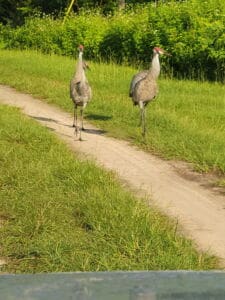
While many people assume development pushes wildlife farther away, Florida’s resident sandhill cranes have learned to live alongside people in surprising ways.
That doesn’t mean development has been entirely beneficial.
According to the Florida Fish and Wildlife Conservation Commission (FWC), Florida is home to two subspecies of sandhill cranes. While greater sandhill cranes migrate to Florida each winter before returning north to breed, Florida sandhill cranes live here year-round.
Their natural habitat includes open prairies, pastures and freshwater wetlands, but they have also adapted to developed areas that offer similar features.
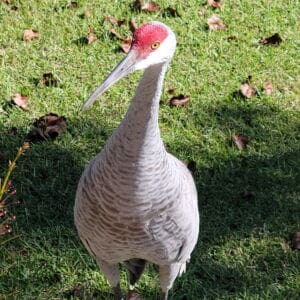
“Florida sandhill cranes can be found in urban and suburban areas that have features similar to their natural habitat, including open settings, particularly mowed grass, water features and food sources such as earthworms, mole crickets and turf grubs,” says Lisa Thompson, communications specialist for FWC’s Division of Habitat and Species Conservation.
“That’s why you may see Florida sandhill cranes using golf courses, suburban neighborhoods and even airports for foraging and, in some cases, nesting.”
The same landscapes that provide food and open space also create new dangers.
Vehicle collisions are among the leading causes of mortality for Florida sandhill cranes. Loose pets, contaminants and people feeding the birds can also create conflicts between cranes and humans.
Although the birds may appear comfortable around people, Lisa says that doesn’t mean they’re tame.
“Being accustomed to people and traffic doesn’t mean these areas are safe for cranes,” she says.
“Vehicle strikes are a leading cause of Florida sandhill crane mortalities.”
Late summer is also when many residents notice crane families moving through neighborhoods and crossing roads. That’s because the chicks, which hatch in secluded wetlands, leave the nest with their parents shortly after hatching in search of food.
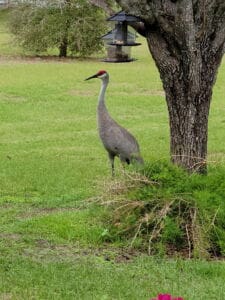
Juvenile cranes cannot fly for about the first two months of their lives, making them especially vulnerable to traffic, predators and becoming separated from their parents by fences or other obstacles. Young cranes typically stay with their parents for 9 to 10 months before the next breeding season.
If a crane family is crossing a road, Lisa says the best thing people can do is slow down when it’s safe and let them cross together.
“People should give cranes with young plenty of space and avoid approaching or handling chicks,” she says. “Sandhill cranes are wild animals, and approaching or attempting to handle them could result in injury to either the birds or people.”
Feeding sandhill cranes is also illegal in Florida and can cause the birds to lose their natural fear of people, increasing the likelihood of conflicts and putting both cranes and people at risk.
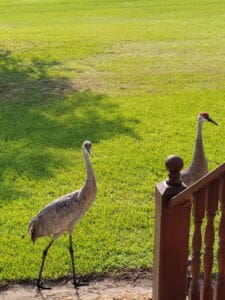
“Don’t feed sandhill cranes and enjoy them from a distance,” Lisa says. “Florida sandhill cranes are a state-designated threatened species. They have long been part of Florida’s landscape and can live alongside people, but they still depend heavily on natural wetlands and face hazards associated with sharing the landscape with us.”
To learn more about Florida sandhill cranes, visit the Florida Fish and Wildlife Conservation Commission
To report illegal feeding or harassment of sandhill cranes or other wildlife violations:
FWC Wildlife Alert Hotline: 888.404.3922 (888.404.FWCC)
























Gina moved to Central Florida from the San Francisco Bay Area in 2021. She holds a degree in linguistics and has worked as a fashion editor, photo stylist, lifestyle columnist and food writer since 1995. She later covered travel, events, restaurants, music festivals and sports throughout Northern California, including work as a morning show host with KSAN radio and food critic for KRON Bay TV. A veteran bartender, she has worked in hospitality on and off since high school. Gina joined Akers Media in 2022 and is currently the Food and Lifestyle Editor. Her passions include travel, road trips, history books and podcasts, tasting menus and arriving in a new city without a map.