
By Cindy Peterson
Florida Amendment 3: What It Means for Your Property Taxes








Property taxes have become one of Florida’s hottest political issues, and when voters see Amendment 3 on their November ballot, the promise of relief may sound simple.
The reality is more complicated.
Amendment 3 would substantially reduce property taxes on qualifying homesteaded properties, but it would not eliminate property taxes altogether. School taxes would remain. Non-ad valorem assessments — charges that may appear on a tax bill for services such as solid waste or fire assessments — would remain.
And the amendment applies differently depending on whether a property is a primary residence, rental, second home or business.
“It’s a reduction, but there is no elimination,” says Tyler Brandeburg, chief deputy of the Lake County Tax Collector’s Office. “Amendment 3 would substantially increase the homestead exemption for non-school property taxes and create a process that could allow the exemption to grow further in the future.”
So what exactly are Floridians voting on?
First, the homestead exemption gets much bigger
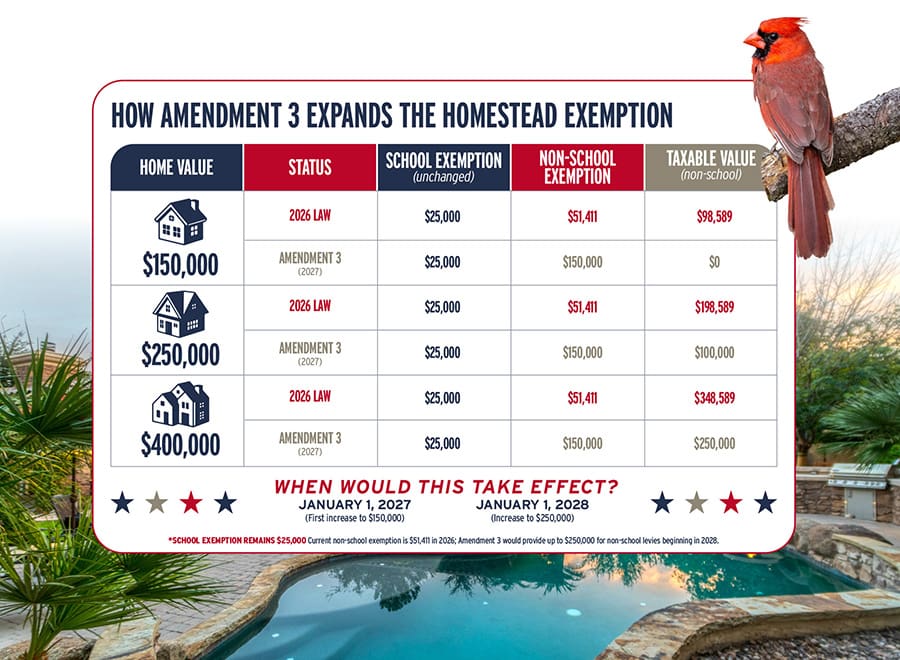
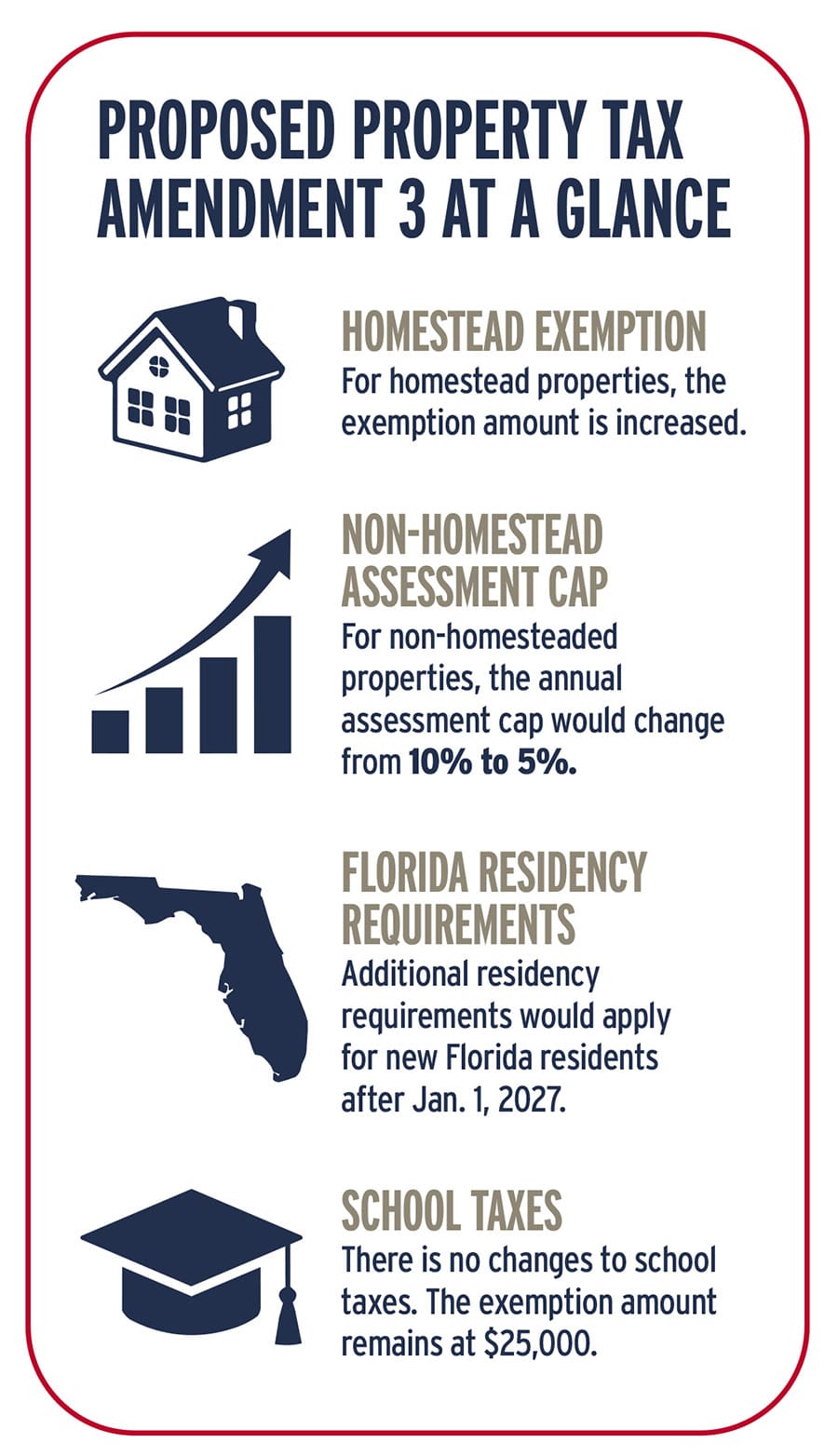
For 2026, Florida homeowners who qualify for a homestead exemption receive a $25,000 exemption from school-district levies and a $51,411 exemption from most non-school levies.
Amendment 3 would increase the exemption for non-school property taxes to $150,000 beginning Jan. 1, 2027, then to $250,000 in 2028. Beginning in 2029, that $250,000 amount would be adjusted for inflation.
Think of the exemption as the portion of a home’s assessed value that local governments cannot tax.
Consider a home with an assessed value of $250,000.
Under the current system, a homeowner might have roughly $200,000 remaining subject to certain non-school property taxes after the standard exemption. With a $150,000 exemption, that taxable amount could fall to about $100,000. Once the exemption reaches $250,000, the homeowner could potentially have no remaining taxable value for those particular non-school levies.
But that does not mean a zero-dollar tax bill.
School district property taxes are specifically excluded from the expanded exemption, meaning homeowners would continue paying those taxes based on the applicable taxable value. Other assessments appearing on the bill may also continue.
And nothing changes on the property taxes due this November. If approved, the amendment takes effect Jan. 1, 2027.
It’s about your primary home
The largest benefit applies to homesteaded property, generally the home a Florida resident owns and uses as a permanent residence.
Rental properties, second homes and commercial buildings do not receive the new $150,000 and $250,000 homestead exemptions.
However, Amendment 3 also changes the rules for those properties. Currently, annual assessment increases on many non-homesteaded properties are capped at 10%. The amendment would lower that maximum increase to 5%.
That limits how quickly the assessed value used for taxation can rise, but it does not freeze the tax rate itself.
That distinction matters because a property tax bill is based on more than the value of the property. Local governments also set millage rates — the tax charged for every $1,000 of taxable value.
New residents face a wait
Amendment 3 also creates a significant difference between current Floridians and those establishing residency later.
People who are Florida residents by Dec. 31, 2026, and otherwise qualify would be eligible for the expanded exemption. Those who establish Florida residency after that date would initially receive the existing homestead exemption and would not qualify for the enhanced benefit until their fifth year of exemption, subject to federal constitutional requirements.
That provision is intended to give the larger tax benefit first to established Florida residents.
What happens to local government?
This is where the debate becomes considerably bigger than an individual homeowner’s tax bill.
Property taxes are a major source of revenue for counties, municipalities and special districts, helping fund law enforcement, fire protection, roads, stormwater systems, parks, libraries, government operations and other services.
Preliminary figures based on data from the Lake County Property Appraiser’s Office illustrate the potential size of the shift.
Using current just values, the analysis estimates the taxable value available to Lake County’s general fund could decline about 19.5% in the first year under the $150,000 exemption and approximately 31.9% once the $250,000 exemption and 5% assessment cap are in effect.
The effects vary by municipality. Preliminary estimates show Clermont’s taxable base falling about 16.5% initially and 28.5% in the second stage; Leesburg about 16.8% and 28.2%; Mount Dora about 17.6% and 30.5%; and Groveland about 21.6% and 37.9%.
Those figures represent reductions in taxable value, not necessarily identical percentage reductions in each government’s overall budget. Local governments have other revenue sources, and the estimates are preliminary.
Lake County’s tax base has also grown substantially
Lake County Property Appraiser records show the taxable value supporting the county general fund was about $16.27 billion in 2015. By 2025, it had grown to approximately $44.85 billion, an increase of about 176%.
During roughly the same period, the Lake County Board of County Commissioners’ general-fund property tax levy grew from about $86.3 million to $225.4 million, or approximately 161%.
That growth provides important context for both sides of the debate. Supporters of tax relief point to rapidly rising values and local revenues. Local officials counter that population growth, inflation and the cost of providing services have also increased substantially.
Sumter County prepares for major cuts
Sumter County has also experienced substantial growth in recent years. U.S. Census Bureau estimates put the county’s population at 157,772 in 2025, up from 129,752 at the 2020 Census — an increase of about 21.6% in just five years.
That growth has brought more homes, development and taxable property, but it has also increased demand for county services and infrastructure. The competing effects are important context as county leaders consider how a significant reduction in property-tax revenue could affect a rapidly growing community.
Sumter County officials say they are already planning for the possibility that Amendment 3 passes.
County Commission Chairman Don Wiley says the Florida Association of Counties provided estimates showing Sumter could lose about $24 million from a roughly $120 million budget in the first stage of implementation.
“We’ve been very proactive,” Wiley says.
He says the county began by identifying services required by state law, which account for the majority of county spending, then examining programs and staffing that are not legally mandated.
Among the services under review are libraries, veterans services, animal services and other county operations. Wiley says the county’s working scenario includes eliminating approximately 52 positions, reducing animal-services staffing, closing all but three libraries, ending county veterans services and closing county facilities including the Tax Collector Annex building near County Road 466 and Morse Boulevard.
Those are county planning assumptions if the amendment passes, not cuts mandated directly by Amendment 3.
Wiley says the problem becomes more difficult because the second stage of the exemption would create another reduction the following year.
“The first year is going to be tough,” he says. “Second year, that’s going to be even harder.”
He says Sumter County cannot simply eliminate many of its largest responsibilities because services such as law enforcement and other core government functions are either legally required or protected under the amendment.
“Would I like to see a decrease in property taxes?” he asks. “Absolutely. But this doesn’t work doing it this way. Too much too fast.”
His broader warning to voters is straightforward: reductions in taxes may also mean reductions in services.
Where would the money come from?
“What would be on the chopping block would be parks and recreation, libraries, trail systems, all the extra stuff that doesn’t directly affect day-to-day government, but does affect quality of life,” Tyler says. “The funding still has to come from somewhere.”
Amendment 3 does not itself dictate that libraries close, park fees rise or government employees lose jobs.
It does, however, reduce the property tax base available to many local governments, leaving elected officials to balance the difference through some combination of spending reductions, different tax rates, other revenue sources or fees and assessments.
“The amendment identifies categories for which counties and municipalities may use property-tax revenue, including public safety, infrastructure, natural resources, debt obligations, employee retirement benefits and government operations and administration,” says Rick Martin, Chief Administrative Officer at the Lake County Tax Collector’s Office. “It also permits other expenditures approved by the appropriate county officer or local governing body unless prohibited by general law. The practical effect of this provision may depend on future legislation and its implementation.”
DeSantis still supports it
Gov. Ron DeSantis has been a strong advocate for reducing property taxes, although he has acknowledged Amendment 3 is less aggressive than the approach he originally sought.
During a recent appearance in The Villages, DeSantis described the measure as a significant tax cut and urged Floridians to support it.
“I think everyone should vote for it,” DeSantis says, adding that he believes local governments can absorb reductions after years of increased revenue. He also suggested the state could consider grants for local governments facing legitimate difficulties after implementation.
He has not withdrawn his support. DeSantis says the amendment is still “good for taxpayers” and that he intends to vote for it, but he has characterized his own proposal as part of a broader effort to move Florida closer to much deeper property-tax reductions.
Amendment 3 does not immediately eliminate non-school property taxes, but it creates a path toward further exemptions. The measure directs the Legislature to establish a uniform process that could eventually allow counties and municipalities to increase homestead exemptions up to the full assessed value. Special districts could do so with voter approval.
What a “yes” or “no” vote means
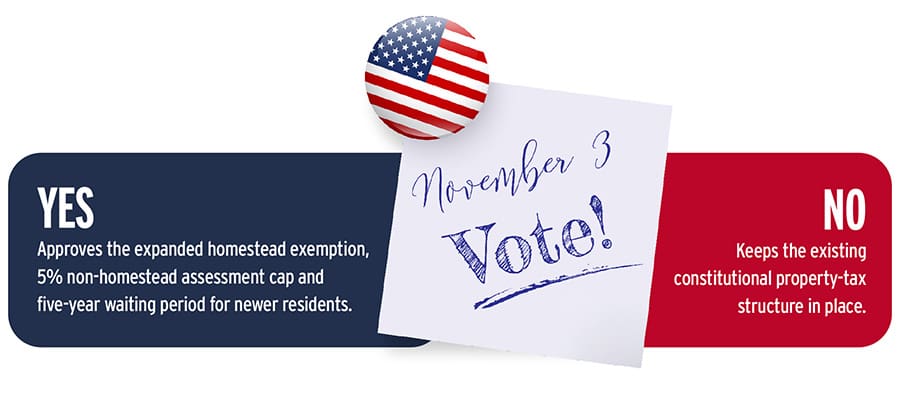
A yes vote approves the expanded homestead exemption, lower assessment-growth cap for non-homestead property, five-year waiting period for certain newer residents and other changes contained in the amendment.
A no vote keeps the existing constitutional property-tax structure in place.
A simple majority is not enough.
Amendment 3 must receive at least 60% of the statewide vote to pass.
Whatever voters decide, one misconception can be cleared up before Election Day.
The question on the ballot is not whether Floridians should pay property taxes or no property taxes.
It is about who pays how much, which property is taxed and how Florida’s local governments will be funded going forward.
The Bottom Line
Amendment 3 would not eliminate property taxes. It would determine how much of a homesteaded property’s value is taxable, how quickly non-homestead property assessments can rise for tax purposes and how Florida’s local governments may use remaining property-tax revenue.
Homestead Chart provided by Lake County
























Cindy serves as Executive Editor of Style Magazine and is a multimedia specialist in journalism, photography, videography and video editing. She holds a Bachelor of Science in Communications from the University of Central Arkansas and produces Style Magazine’s Sports Hub Podcast and Style Podcast. Cindy also serves as a producer for Beacon College’s Telly Award-winning PBS show, “A World of Difference.” When she isn’t working, Cindy enjoys traveling to national parks with her husband, Ryan, and son, David, while photographing wildlife — especially squirrels.