
By Roxanne Brown
Groveland Train Depot Transfer Honors City’s Past and Future





For decades, Groveland’s old train depot has stood beside the road, a reminder of the people and industries that helped build the city and of a young man whose life changed there forever.
On Friday, Oct. 30, the community gathered to give the 101-year-old landmark a future and accept responsibility for the history it holds.

The ceremonial transfer of the depot at 122 State Road 19 to the City of Groveland marked a milestone nearly two decades in the making. City leaders, preservation advocates and representatives of Avalon Park Group celebrated the acquisition with plans to restore the building as a gathering place, downtown gateway and trail hub.
But the occasion also carried a deeply personal meaning for the family of Charles Greenlee, the youngest of the Groveland Four, who was taken into custody at the depot in 1949.
Throughout the ceremony, speakers returned to the obligation that comes with preserving such a place: remembering its promise and its pain.
“This building is more than brick, timber and rail history as it stands as the heart of the story of how Groveland grew,” Groveland Mayor Keith Keogh says. “This station connected our community to the wider world and helped move the goods and industries that sustained us, like perfume, turpentine, lumber and, of course, our famous citrus industry. Today, we honor that history and recognize how far this community has really come.”

He also recognized that this achievement has been years in the making and thanked past council members for helping the current council get to this stage.
“This has been a dream for a long, long time,” he says. “I’d like the past city council members that are here today to please stand.”
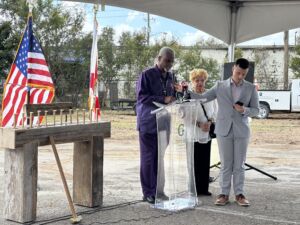
The ceremony included an invocation by Pastor Bishop Wilkes of First Missionary Baptist Church and the Pledge of Allegiance.
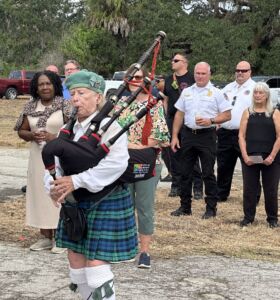
After the pledge, Linda Charlton of the City of Mount Dora Pipes and Drums performed on the bagpipes.
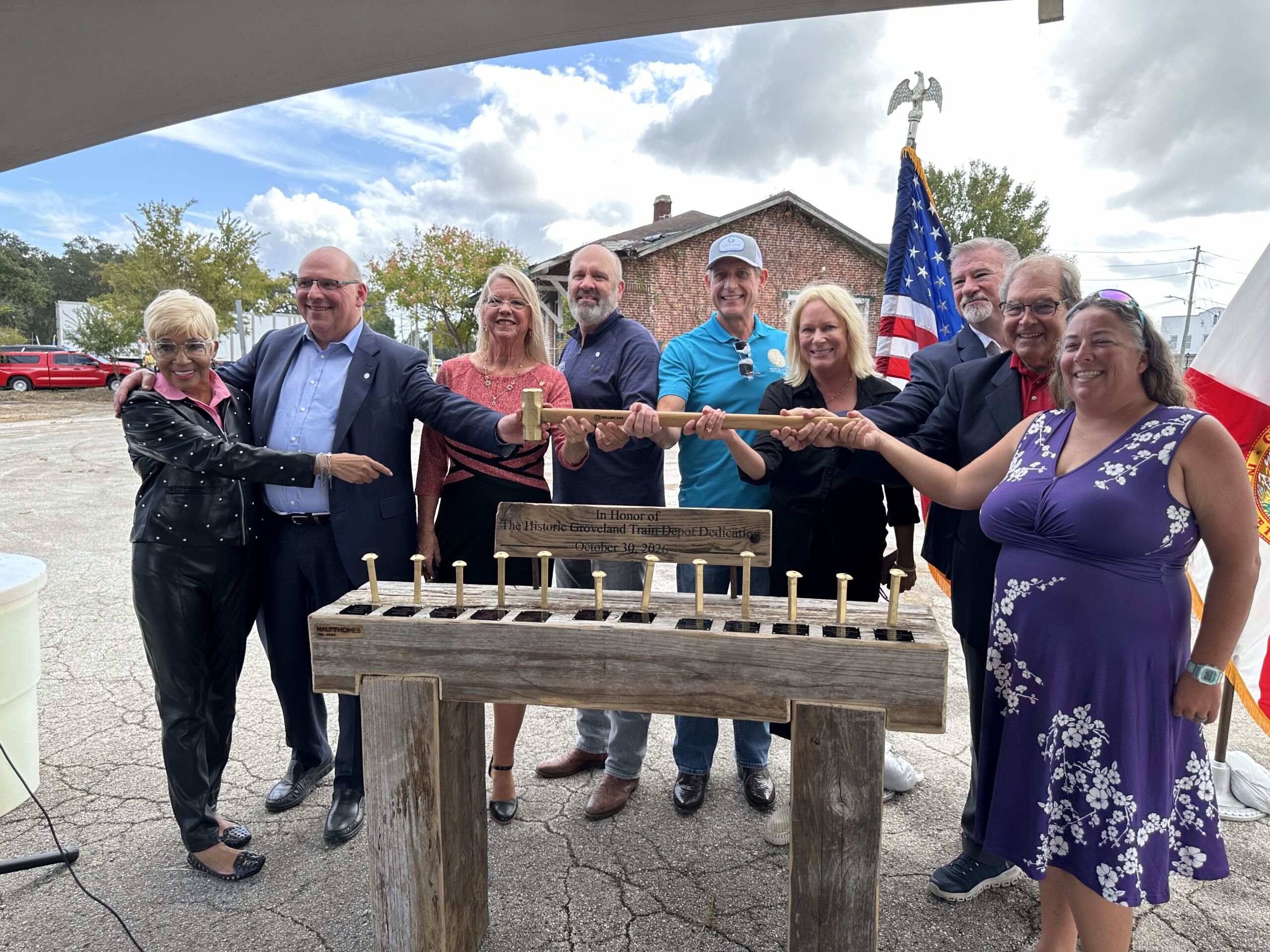
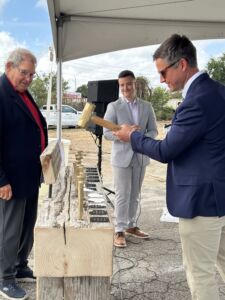
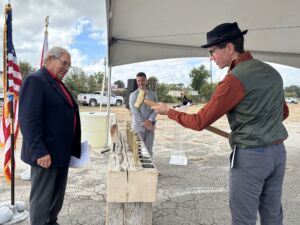
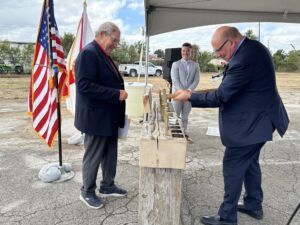
Speakers and city officials also drove golden railroad spikes into an antique pine beam, a symbolic commitment to the restoration ahead. Keith described the beam as lumber produced locally more than a century ago.
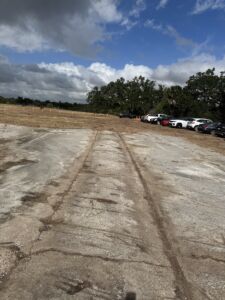
While crews prepared the property for the ceremony, they uncovered something else: old railroad tracks pointing toward the new bypass.
“It’s kind of a symbol of the past and the future coming together,” Keith says.
Built in 1925, the depot served a community whose relationship with the railroad began much earlier. Rail service reached the area in 1887, helping the settlement known as Taylorville grow through passenger travel and shipments of timber, citrus and other goods.
As rail use declined, the depot eventually became a guardhouse for the neighboring B & W Canning Company. Its preservation became an early priority for the Groveland Historical Society, formed in 2007.
Local historian Doris Bloodsworth remembered former Councilman Johnny Griffin, who supported saving the building when the society began, and the city leaders who continued that work after him.
For Doris, watching the depot deteriorate was personal.
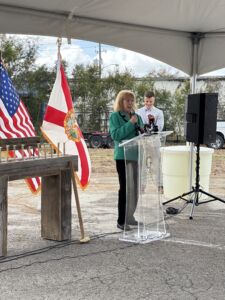
“You see its condition and so over the years when I would drive by and see weeds, I felt pain, but it’s a lot like all of us, right?” she says. “Along the years we have dents, but it just forms our character so when I look at it today knowing it’s gonna be restored, it brings me great joy.”
She also recalled a downtown where the smell of processing oranges drifted through the air, and painted a picture of Greenlee that hit hard.
“Charles Greenlee, a teenager, sat on the dock, legs dangling, soda pop in hand, you can almost imagine it, waiting for the ride that never came,” she says.
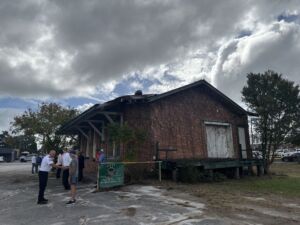
Now, the building’s next purpose will take shape alongside another major transportation change.
The Florida Department of Transportation is constructing a 2.1-mile, four-lane realignment of State Road 50 north of downtown, with a new intersection at SR 19. The project will divert substantial heavy truck traffic from downtown and turn Broad and Orange streets into city streets, creating opportunities for a safer, more walkable district. Construction is expected to finish in summer 2028.
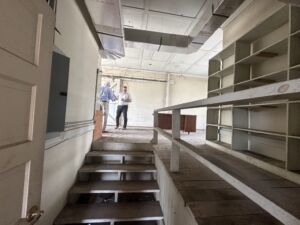
The depot is envisioned as a gateway into that downtown, with a brick pedestrian plaza and connections to the expanding trail network.
Interim City Manager Tim Maslow described a future with gathering spaces, local businesses and activity centered around the historic depot.
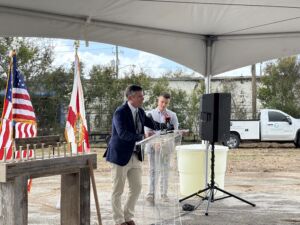
“This project brings together some of the best things in community health,” Tim says. “Historic preservation, walkable downtowns, its trails.”
“Our mission is for downtown Groveland to become a premier trail-oriented development, embodying our core value of connectivity and creating new opportunities for economic prosperity and quality of life.”
The city has budgeted $500,000 for the first restoration phase, with a later phase planned to include event space. Tim outlined a schedule calling for architectural concepts in January 2027, final design approval in March and construction bidding in June, with a goal of completing restoration by the end of 2027.
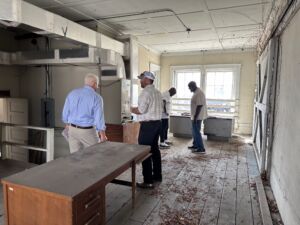
For Jason Brown, president of the Groveland Historical Society, the transfer brings closer the possibility of housing the city’s history museum inside the landmark.
He sees the building’s location and the city’s plans for a more walkable downtown as an opportunity to give local history a more central place in community life.
“This is a step in the right direction,” Jason says.
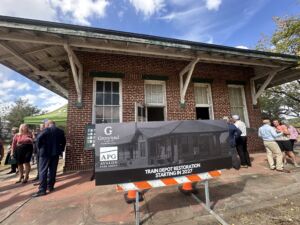
State Rep. Taylor Yarkosky credited residents and leaders for continuing to support preservation.
“One of the things that’s really cool about Groveland and about Lake County is, we show up to preserve, we show up to pay respect,” Taylor says.

That responsibility extends to the depot’s connection to racial injustice.
Charles Greenlee was 16 and looking for work to support his pregnant wife when he was arrested. He, Walter Irvin, Samuel Shepherd and Ernest Thomas became known as the Groveland Four — young Black men falsely accused of raping a white woman in 1949. They received posthumous pardons in 2019 and were formally cleared in 2021.
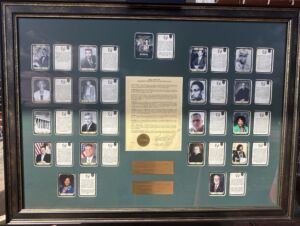
Charles’ daughter, Carol Greenlee, could not attend Friday’s ceremony. Vice Mayor Barbara Gaines read her message, bringing the consequences of that arrest back to the place where it happened.
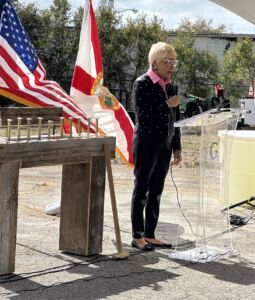
“My father, Charles Greenlee, was in Lake County for a simple reason,” Carol wrote. “He wanted to provide for his family.”
Her mother was pregnant with Carol at the time.
“He had suffered the worst of the worst. Yet he became the best of the best,” her message continued.
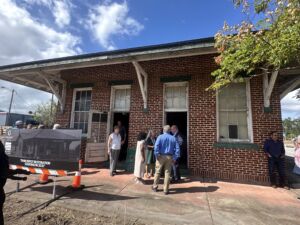
Carol described a father who devoted his life after prison to caring for others and teaching his children gratitude, honesty and forgiveness.
Barbara urged the community to carry that history into the depot’s next chapter.
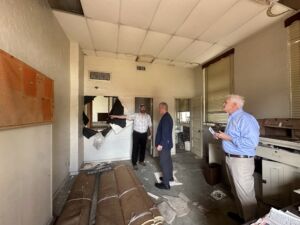
“Let it remind us that while we cannot change the past, we can choose how we remember and how we carry its lessons forward,” she says.
Lake County Commission Chair Leslie Campione recalled advocating before the governor and clemency board for the Groveland Four’s pardons, an experience she described as among the most meaningful of her public service.
She also spoke about the responsibility to protect the county’s identity as it changes.
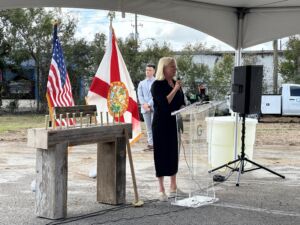
“As we make progress, we need to continue to preserve those things that make Lake County special,” Leslie says.
Barbara echoed that idea in her speech.
“As we celebrate the transfer of this historic train depot to the city of Groveland, we are not simply preserving a structure,” she says. “We are preserving a story. A story of resilience, justice and remembrance.”
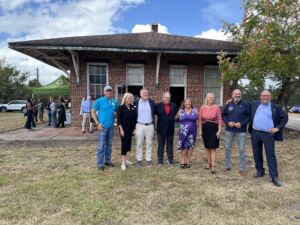
For Beat Kahli, president and CEO of Avalon Park Group, transferring the property represents a commitment to the people who will encounter it years from now — children who may enter the restored building and learn both how Groveland grew and why residents fought to save this piece of it.
“Because great communities aren’t defined only by what they build,” Beat says. “They are also defined by what they choose to preserve.”
























Originally from Nogales, Arizona, Roxanne worked in the customer service industry while practicing freelance writing for years. She came on board with Akers Media in July 2020 as a full-time staff writer for Lake & Sumter Style Magazine and was promoted to Managing Editor in October 2023—her dream job come true. Prior to that and after just having moved to Florida in 1999, Roxanne had re-directed her prior career path to focus more on journalism and went on to become a reporter for The Daily Commercial/South Lake Press newspapers for 16 years. Additionally, Roxanne—now an award-winning journalist recognized by the Florida Press Club and the Florida chapter of The Society of Professional Journalism—continues working toward her secondary goal of becoming a published author of children’s books.